Global Economic Trends That Will Shape the Future in 2026
The world economy is quietly yet powerfully being reshaped by technology, changes in consumer behavior, and new business models. Market forces such as digitalization, innovation, and cross, border trade are replacing political decisions as the primary factors changing the pace and direction of growth and interaction among economies. Those businesses and individuals who can spot these trends ahead of time will be able to adapt more quickly and remain competitive in the global economy that is changing at high speed.
The global digital transformation is one of the largest economic trends worldwide. Businesses in all sectors are investing in automation, artificial intelligence, and cloud computing to increase output and lower the cost of operations. Digital solutions are accelerating decision, making and bringing new revenue streams in both manufacturing and services sectors, thus making technology a predominant factor in the expansion of the global economy.
There is yet another element that plays a big role in reshaping the economy at a global scale one is certainly the economic rise of the developing countries or more simply the emerging markets. A few of these countries are located in continents such as Asia and Africa, and in some cases even parts of Latin America. They are becoming more and more industrialized and getting their startups going which eventually leads to a surge in their consumption. Since these markets have a predominantly young population and are getting connected to the Internet at an accelerating rate, they are turning into significant players in world commerce and capital flows, thereby luring in foreign companies and investors.
Additionally, the worldwide supply chain is undergoing changes as well. Instead of solely focusing on minimizing the costs, corporations nowadays are putting their attention and efforts into making their supply chain capable of withstanding various shocks. Most of the time companies are splitting their suppliers, localizing the sources as far as the possibility allows, and at the same time, they are purchasing smart logistics technology. Such a change is paving the way for small manufacturing businesses, exporters, and logistics service providers globally.
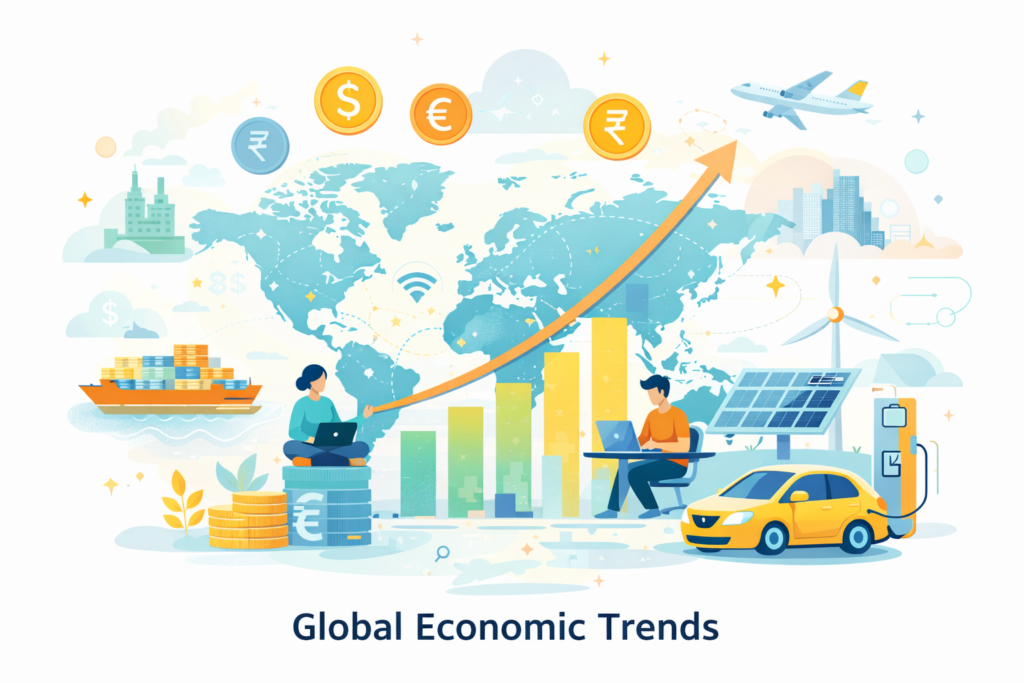
Sustainability, green economy are not just good to have them, they are now main strong economic driver. Globally, renewable energy, electric mobility, sustainable packaging, and eco, friendly products are creating a lot of jobs and attracting investments. The consumers are nowadays supporting mostly those companies which are responsible and follow sustainable practices. They are thus influencing the long, term economic strategies of these companies.
The digital services economy is continuously growing tremendously. With online education, remote work, digital payments, and e, commerce, the global markets have been connected in an unprecedented way. It is now possible for freelancers, small businesses, and startups to serve customers from different parts of the world without having much infrastructure by which they have become a part of the more inclusive global economic system.
Consumer behavior represents a major force that continuously influences economic trends. Contemporary consumers put their emphasis on value, convenience, and personalization. Trading, as well as reaching and expanding customers worldwide especially via online marketplaces, are being revolutionized by data, driven marketing, e, commerce customer experience optimization, and direct, to, consumer models.
To sum up, several factors, including innovation, sustainability, digital growth, and the changing landscape of trade are determining the global economy rather than politics. Being aware of these global economic trends provides a great advantage for businesses, entrepreneurs, and professionals in decision, making, gearing up for change, and unlocking new potentials in the interconnected and competitive world economy.